Leetcode review
399. Evaluate Division
問題描述:
You are given an array of variable pairs equations and an array of real numbers values, where equations[i] = [Ai, Bi] and values[i] represent the equation Ai / Bi = values[i]. Each Ai or Bi is a string that represents a single variable.
You are also given some queries, where queries[j] = [Cj, Dj] represents the jth query where you must find the answer for Cj / Dj = ?.
Return the answers to all queries. If a single answer cannot be determined, return -1.0.
Note: The input is always valid. You may assume that evaluating the queries will not result in division by zero and that there is no contradiction.
Note: The variables that do not occur in the list of equations are undefined, so the answer cannot be determined for them.
Example 1:
1 | Input: equations = [["a","b"],["b","c"]], values = [2.0,3.0], queries = [["a","c"],["b","a"],["a","e"],["a","a"],["x","x"]] |
Example 2:
1 | Input: equations = [["a","b"],["b","c"],["bc","cd"]], values = [1.5,2.5,5.0], queries = [["a","c"],["c","b"],["bc","cd"],["cd","bc"]] |
Example 3:
1 | Input: equations = [["a","b"]], values = [0.5], queries = [["a","b"],["b","a"],["a","c"],["x","y"]] |
這是一道典型的圖論相關問題,思路是構造一個鄰接矩陣matrix, matrix[i][j]代表i/j的值,如果沒有這個值就爲0。
構造好這個矩陣之後就可以通過BFS去遞歸的尋找關繫,比如在Example 1中需要找到a/c,那麼就可以先通過dfs找到a/b,然後再通過dfs進一步找到b/c從而獲得a/c。
具體的代碼思路如下
1 | class Solution { |
時間複雜度分析:
構建map映射,即字符串和matrix中對應下標時的複雜度爲
O(E),E爲Equations的大小。構建鄰接矩陣時的複雜度爲
O(E)。dfs方法在調用時最壞情況下會遍曆鄰接矩陣的每一個值,假設共有n個不同的字符串,即鄰接矩陣有n^2個值,所以時間複雜度爲
O(n^2)。for循環遍曆queries時,假設共有Q個query,那麼每次調用一次dfs,時間複雜度爲
O(Q * n^2)
綜上時間複雜度爲O(E + Q * n^2)。
空間複雜度分析:
- matrix共有n^2個節點,複雜度爲
O(n^2) - map共存儲n個節點,複雜度爲
O(n) - dfs時遞歸的深度可能會達到所有節點,複雜度爲
O(n) - dfs時的set最壞情況會包含所有節點,複雜度爲
O(n) - res數組假設有Q個query,複雜度爲
O(Q)
綜上空間複雜度爲O(Q + n^2)
994. Rotting Oranges
問題描述:
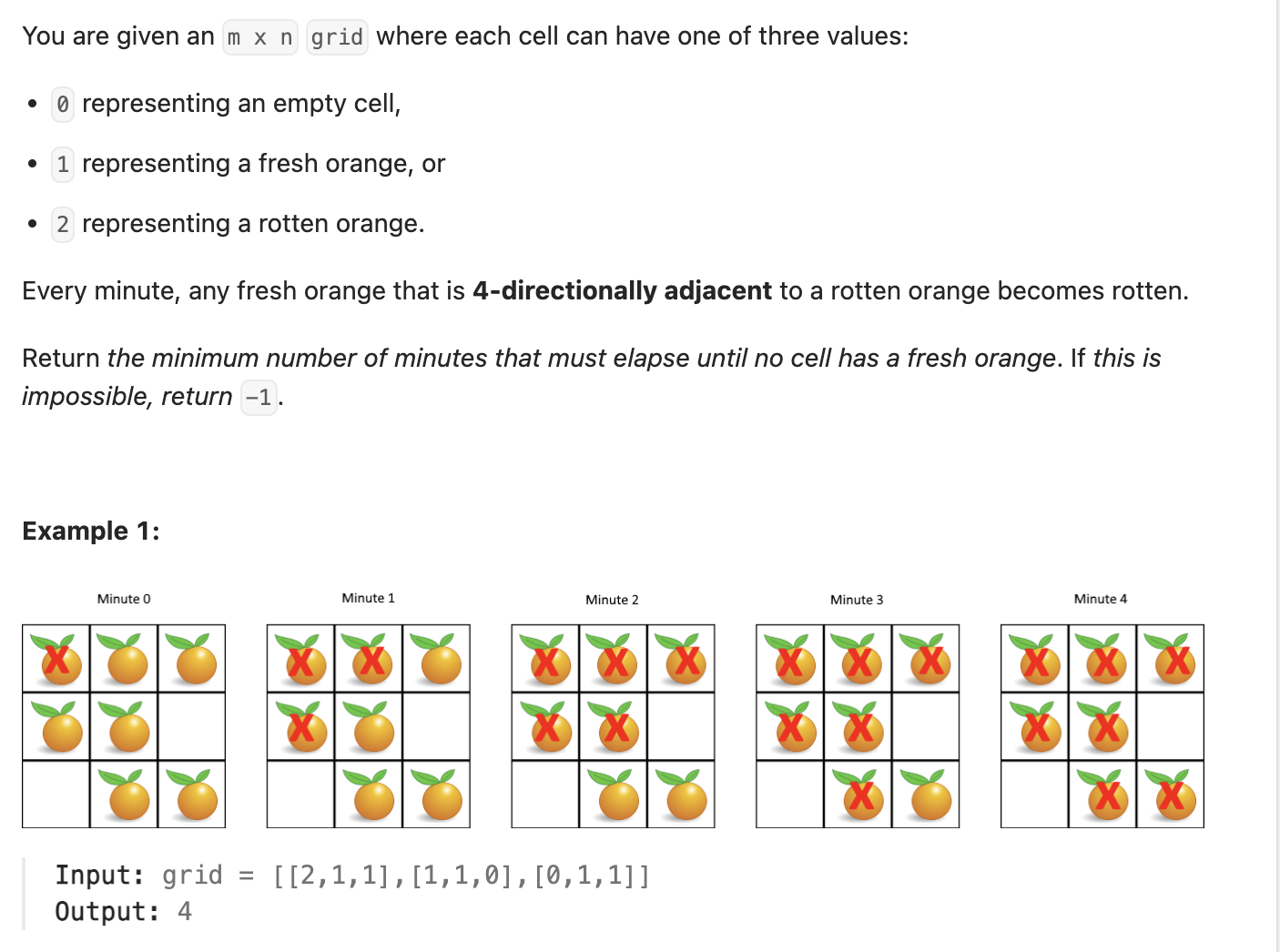
思路是先遍曆grid,如果找到“爛橘子”就加入到Queue中,遍曆完成之後對Queue中的所有“爛橘子”進行BFS並記錄每次BFS的時間,動態更新最長時間。最後檢查一遍grid,如果還存在新鮮的橘子就返回-1,如果沒有就返回最長時間。
代碼如下:
1 | class Solution { |
時間複雜度分析:
- 兩個for循環的時間複雜度爲
O(n*m),n和m分別爲grid的長和寬 - bfs最壞情況下會遍曆每一個節點,時間複雜度爲O(n*m)。
綜上時間複雜度爲O(n*m)
空間複雜度分析:
- queue最壞情況下會包含所有節點,空間複雜度爲
O(n*m)
綜上空間複雜度爲O(n*m)
875. Koko Eating Bananas
Koko loves to eat bananas. There are n piles of bananas, the ith pile has piles[i] bananas. The guards have gone and will come back in h hours.
Koko can decide her bananas-per-hour eating speed of k. Each hour, she chooses some pile of bananas and eats k bananas from that pile. If the pile has less than k bananas, she eats all of them instead and will not eat any more bananas during this hour.
Koko likes to eat slowly but still wants to finish eating all the bananas before the guards return.
Return the minimum integer k such that she can eat all the bananas within h hours.
Example 1:
1 | Input: piles = [3,6,7,11], h = 8 |
Example 2:
1 | Input: piles = [30,11,23,4,20], h = 5 |
Example 3:
1 | Input: piles = [30,11,23,4,20], h = 6 |
可以使用二分查找不斷縮小符合要求的最小速度,直到找到最小的速度
代碼如下:
1 | class Solution { |
因爲每一堆香蕉的最大數量爲10^9,所以可以設置最大速度爲10^9,最小速度爲1。然後就可以進行二分查找,不斷縮小速度。
值得注意的是在check()方法中用於記錄用時的變量hours需要設置爲long,不然會有溢出的風險。
時間複雜度分析:
- piles的長度爲n,每次二分查找都需要遍曆一次piles數組,複雜度爲
O(n) - 二分查找的範圍是1-10^9,所以複雜度爲
O(10^9) - 綜上時間複雜度爲
O(10^9n)
空間複雜度爲O(1)
962. Maximum Width Ramp
A ramp in an integer array nums is a pair (i, j) for which i < j and nums[i] <= nums[j]. The width of such a ramp is j - i.
Given an integer array nums, return the maximum width of a ramp in nums. If there is no ramp in nums, return 0.
Example 1:
1 | Input: nums = [6,0,8,2,1,5] |
Example 2:
1 | Input: nums = [9,8,1,0,1,9,4,0,4,1] |
這道題其實簡單來説就是找到和每個元素對應的不小於它的最遠的元素,並且得到距離的最大值。
具體的做法是維護一個單調遞減棧,從左向右遍曆。再從右向左遍曆,如果棧頂的元素小於等於遍曆到的元素,就出棧並記錄最大距離,知道棧空。
代碼如下:
1 | class Solution { |
時間複雜度分析:
- 維護單調棧需要遍曆每個元素,
O(n)。 - 第二次從右向左遍曆元素最壞情況下需要遍曆全部元素,
O(n)。
時間複雜度爲O(n)。
空間複雜度分析:
- 最壞情況
stack需要記錄全部元素,O(n)。
空間複雜度爲O(n)。
2406. Divide Intervals Into Minimum Number of Groups
You are given a 2D integer array intervals where intervals[i] = [lefti, righti] represents the inclusive interval [lefti, righti].
You have to divide the intervals into one or more groups such that each interval is in exactly one group, and no two intervals that are in the same group intersect each other.
Return the minimum number of groups you need to make.
Two intervals intersect if there is at least one common number between them. For example, the intervals [1, 5] and [5, 8] intersect.
Example 1:
1 | Input: intervals = [[5,10],[6,8],[1,5],[2,3],[1,10]] |
Example 2:
1 | Input: intervals = [[1,3],[5,6],[8,10],[11,13]] |
這道題可以用時間線和事件的思路去解決,不必拘泥於時間對,而是把每一個時間對拆開,將其視爲開始時間和結束時間。
同時使用一個最小堆對時間進行排序,當存在開始時間和結束時間相同時先處理開始時間。維護一個變量記錄同時存在的事件的最大數量,即爲答案。
代碼如下:
1 | class Solution { |
時間複雜度分析:
- 假設intervals有n個事件,那麼一共有2n個時間點,插入堆的複雜度爲
O(log2n),綜合複雜度爲O(2nlog(2n)) = O(nlogn)。
空間複雜度分析:
- 堆需要
O(2n) = O(n)的空間
632. Smallest Range Covering Elements from K Lists
You have k lists of sorted integers in non-decreasing order. Find the smallest range that includes at least one number from each of the k lists.
We define the range [a, b] is smaller than range [c, d] if b - a < d - c or a < c if b - a == d - c.
Example 1:
1 | Input: nums = [[4,10,15,24,26],[0,9,12,20],[5,18,22,30]] |
Example 2:
1 | Input: nums = [[1,2,3],[1,2,3],[1,2,3]] |
涉及到“最大”“最小”問題時,往往需要考慮使用heap,因爲這類問題需要頻繁地獲得最大最小值,而堆可以實現在O(1)的複雜度下得到最值,從而降低時間複雜度。
每一輪將一列元素存入heap,將最小值移出,並且動態的更新最大最小值,並記錄range,再將移出元素的下一個元素加入heap,直到heap中的元素數量小於nums中數組的數量,最終獲得的最小range即爲答案。
1 | class Solution { |
1 | 例一的每一輪處理過程如下 |
時間複雜度分析:
- 設nums中共有k個數組,設共有N個元素,最壞情況下heap需要遍曆每一個元素,每次插入和刪除元素的複雜度爲
O(logk),時間複雜度爲O(Nlogk)。
空間複雜度分析:
- heap中始終存在k個元素,空間複雜度爲
O(k)
1942. The Number of the Smallest Unoccupied Chair
There is a party where n friends numbered from 0 to n - 1 are attending. There is an infinite number of chairs in this party that are numbered from 0 to infinity. When a friend arrives at the party, they sit on the unoccupied chair with the smallest number.
- For example, if chairs
0,1, and5are occupied when a friend comes, they will sit on chair number2.
When a friend leaves the party, their chair becomes unoccupied at the moment they leave. If another friend arrives at that same moment, they can sit in that chair.
You are given a 0-indexed 2D integer array times where times[i] = [arrivali, leavingi], indicating the arrival and leaving times of the ith friend respectively, and an integer targetFriend. All arrival times are distinct.
Return the chair number that the friend numbered targetFriend will sit on.
Example 1:
1 | Input: times = [[1,4],[2,3],[4,6]], targetFriend = 1 |
Example 2:
1 | Input: times = [[3,10],[1,5],[2,6]], targetFriend = 0 |
- 這個問題可以考慮將每個人的時間拆開,分成開始時間和結束時間。將拆開後的時間以數組的形式存入小頂堆中,arr[0]是時間,arr[1]用來記錄是第幾個人,arr[2]用來記錄是到達時間還是離開時間。以arr[0]爲依據排序。
- 同時,一個優先隊列來記錄當前時刻下空的椅子,這樣總是可以得到最小的可以利用的椅子。
- 用一個Map來記錄當前時刻下已經被佔用的椅子,key爲人的序號,value是椅子序號。
- 具體的流程是,按髮生順序依次遍曆每一個時間。如果爲到達時間,就從availableChairs中分配一把椅子,並存入occupiedChairs。並且檢查是否是targetFriend;如果爲結束時間,就將對應的occupiedChairs中的椅子放回avaliableChairs。
1 | class Solution { |
時間複雜度分析:
- 設一共有n個人,events共插入2n次,每次插入的時間複雜度爲
O(logn),複雜度爲O(2nlog2n) = O(nlogn)。 - 將所有椅子加入avaliableChairs,時間複雜度爲
O(nlogn)。 - 依次遍曆每個event,最壞情況下每次都要取一個新的椅子,從avaliableChairs取椅子複雜度爲
O(logn), 插入occupiedChairs複雜度爲(O(1)),總複雜度爲2n(O(logn) + O(1)) = O(nlogn)。
綜上時間複雜度爲O(nlogn)。
空間複雜度分析:
- events需要
O(2n) - avaliableChair最多需要
O(n) - occupiedChair最多需要
O(n)
綜上空間複雜度爲O(n)。
632. Smallest Range Covering Elements from K Lists
You have k lists of sorted integers in non-decreasing order. Find the smallest range that includes at least one number from each of the k lists.
We define the range [a, b] is smaller than range [c, d] if b - a < d - c or a < c if b - a == d - c.
Example 1:
1 | Input: nums = [[4,10,15,24,26],[0,9,12,20],[5,18,22,30]] |
Example 2:
1 | Input: nums = [[1,2,3],[1,2,3],[1,2,3]] |
Constraints:
nums.length == k1 <= k <= 35001 <= nums[i].length <= 50-10^5 <= nums[i][j] <= 10^5nums[i]is sorted in non-decreasing order.
這個題的核心在於要保証選取的範圍至少包含每個子數組中一個元素。考慮到這一點可以在遍曆時使用一個容器,並始終保証容器中恰好有k個元素(k爲子數組的數量)。同時在每次遍曆時需要獲得最大值和最小值來確定範圍,所以理所應當使用一個最小堆。
- 初始化:先把每個子數組的第一個元素放入堆中並記錄最大值。
- 遍曆:一個while循環,每次取出一個元素(最小值),更新最小值,從而更新最小範圍。如果最小範圍變小就記錄當前的狀態。
- 在遍曆的最後把取出的最小元素的下一個元素(如果有)加入堆中,並更新最大值。
- 循環結束時記錄的狀態即爲答案。
代碼如下:
1 | class Solution { |
時間複雜度分析:
- 設共有N個元素, 最壞情況下需要遍曆所有元素。
- 每個元素隻進行一次進出堆的操作,堆中元素的數量始終爲K,進入堆時維護最小堆的複雜度爲
O(logK),出堆時的複雜度爲O(1), 維護堆的時間複雜度爲O(logK)。共有N個元素,重複N次,時間複雜度爲O(N*(O(logK) + O(logK) + O(1))) = O(NlogK)。
空間複雜度分析:
- 堆中最多有K個元素,K爲nums的size。空間複雜度爲
O(K)。
2406. Divide Intervals Into Minimum Number of Groups
You are given a 2D integer array intervals where intervals[i] = [lefti, righti] represents the inclusive interval [lefti, righti].
You have to divide the intervals into one or more groups such that each interval is in exactly one group, and no two intervals that are in the same group intersect each other.
Return the *minimum* number of groups you need to make.
Two intervals intersect if there is at least one common number between them. For example, the intervals [1, 5] and [5, 8] intersect.
Example 1:
1 | Input: intervals = [[5,10],[6,8],[1,5],[2,3],[1,10]] |
Example 2:
1 | Input: intervals = [[1,3],[5,6],[8,10],[11,13]] |
Constraints:
1 <= intervals.length <= 10^5intervals[i].length == 21 <= lefti <= righti <= 10^6
可以畫一個時間軸,把intervals中的每個元素當成一個時間段畫在時間軸上,重疊時間段最多的時間點對應的重疊的數量就是最小需要的分組數。
- 把每個時間段拆成開始時間和結束時間,放入最小堆。
- 依次遍曆堆中每一個元素,在遍曆時,記錄同時存在的時間段的最大數量即爲答案。
代碼如下:
1 | class Solution { |
時間複雜度分析:
- 設intervals數組共有N個元素,則共有2N個元素需要進棧和出棧各一次。時間複雜度爲
O(2N*2*O(log2N)) = O(NlogN)。
空間複雜度分析:
- 堆中最多存在2N個元素,空間複雜度爲
O(2N) = O(N)。
962. Maximum Width Ramp
A ramp in an integer array nums is a pair (i, j) for which i < j and nums[i] <= nums[j]. The width of such a ramp is j - i.
Given an integer array nums, return the maximum width of a *ramp* in nums. If there is no ramp in nums, return 0.
Example 1:
1 | Input: nums = [6,0,8,2,1,5] |
Example 2:
1 | Input: nums = [9,8,1,0,1,9,4,0,4,1] |
Constraints:
2 <= nums.length <= 5 * 10^40 <= nums[i] <= 5 * 10^4
第一種方法是把所有元素按從小到大排序,再遍曆一遍,遍曆過程中維護最小下標並更新最長ramp的距離。
1 | class Solution { |
時間複雜度分析:
- 共有N個元素,排序時間複雜度爲
O(NlogN)。 - 遍曆一遍複雜度爲
O(N)。 - 綜合時間複雜度爲
O(N + NlogN) = O(NlogN)。
第二種方法較爲巧妙,採用一個單調棧(單調遞減)記錄nums中的元素,再倒着遍曆,當棧頂元素不大於當前元素時出棧並更新最大值,直到棧頂元素大於當前元素或棧爲空。
單調棧的作用在這裡其實是一個按倒序排序的”set“, 效果是記錄了每一個可能入棧的元素的最左邊位置(如果有多個相同的元素,隻記錄最左邊的那個),這樣就滿足了最大ramp的要求。
1 | class Solution { |
時間複雜度分析:
- 構建單調棧的過程需要遍曆整個數組,複雜度爲
O(N)。 - 第二次遍曆最壞情況下需要遍曆整個數組,複雜度爲
O(N)。 - 綜合複雜度爲
O(N)。
3152. Special Array II
An array is considered special if every pair of its adjacent elements contains two numbers with different parity.
You are given an array of integer nums and a 2D integer matrix queries, where for queries[i] = [fromi, toi] your task is to check that subarray nums[fromi..toi] is special or not.
Return an array of booleans answer such that answer[i] is true if nums[fromi..toi] is special.
Example 1:
Input: nums = [3,4,1,2,6], queries = [[0,4]]
Output: [false]
Explanation:
The subarray is [3,4,1,2,6]. 2 and 6 are both even.
Example 2:
Input: nums = [4,3,1,6], queries = [[0,2],[2,3]]
Output: [false,true]
Explanation:
- The subarray is
[4,3,1]. 3 and 1 are both odd. So the answer to this query isfalse. - The subarray is
[1,6]. There is only one pair:(1,6)and it contains numbers with different parity. So the answer to this query istrue.
Constraints:
1 <= nums.length <= 10^51 <= nums[i] <= 10^51 <= queries.length <= 10^5queries[i].length == 20 <= queries[i][0] <= queries[i][1] <= nums.length - 1
第一種方法:
- 先遍曆數組,如果找到都是偶數(或奇數)的pair,將較小的下標存入list
- 對每一個query
- 進行二分查找
- 嚐試在list中找到query[0] ~ query[1]範圍內的值
- 找到結果爲false,沒找到爲true
1 | class Solution { |
時間複雜度分析:
- 設共有N個元素,遍曆一遍複雜度爲
O(N) - 設共有Q個query,對每一個query進行二分查找,複雜度爲
O(QlogN) - 綜合複雜度爲
O(N + QlogN)
空間複雜度分析:
- 需要
O(Q)的空間來存儲同奇偶對
還有一種效率更高的解法:
遍曆數組,初始化prefixSum,
prefixSum[0] = 0如果當前元素和上一個元素同爲奇偶,
prefixSum[i] = prefixSum[i - 1] + 1對每一個query,如果
query[1] != query[0]説明範圍內有相鄰的奇數或偶數
1 | class Solution { |
時間複雜度分析:
- 遍曆一遍數組
O(N) - 遍曆Query
O(Q) - 綜合複雜度
O(N + Q)
空間複雜度分析:
- prefixSum需要額外的
O(N)空間
2779. Maximum Beauty of an Array After Applying Operation
You are given a 0-indexed array nums and a non-negative integer k.
In one operation, you can do the following:
- Choose an index
ithat hasn’’t been chosen before from the range[0, nums.length - 1]. - Replace
nums[i]with any integer from the range[nums[i] - k, nums[i] + k].
The beauty of the array is the length of the longest subsequence consisting of equal elements.
Return the *maximum* possible beauty of the array nums after applying the operation any number of times.
Note that you can apply the operation to each index only once.
A subsequence of an array is a new array generated from the original array by deleting some elements (possibly none) without changing the order of the remaining elements.
Example 1:
1 | Input: nums = [4,6,1,2], k = 2 |
Example 2:
1 | Input: nums = [1,1,1,1], k = 10 |
- Constraints:
1 <= nums.length <= 10^50 <= nums[i], k <= 10^5
這個題類似於紥氣球問題452. Minimum Number of Arrows to Burst Balloons, 本質上都是區間問題。但這個問題變成了如何用一支箭紥破最多的氣球(區間)。
雖然是子序列問題,但實際上最終的目的是找重疊數量最多的區間,所以排序是可以的。
思路是先對數組進行排序,再遍曆每個區間的末尾端點, 用二分查找嚐試找到第一個大於當前末尾端點的起始端點,記錄此時的區間數量,每次遍曆都進行更新,最終得到的就是最大值。
代碼如下:
1 | class Solution { |
時間複雜度:
- 排序
O(NlogN) - 外層循環
O(N),內層循環是一個二分查找O(logn),綜合爲O(NlogN) - 綜合複雜度
O(NlogN)
空間複雜度:O(1)
2981. Find Longest Special Substring That Occurs Thrice I
You are given a string s that consists of lowercase English letters.
A string is called special if it is made up of only a single character. For example, the string "abc" is not special, whereas the strings "ddd", "zz", and "f" are special.
Return the length of the *longest special substring* of s which occurs *at least thrice*, or -1 if no special substring occurs at least thrice.
A substring is a contiguous non-empty sequence of characters within a string.
Example 1:
1 | Input: s = "aaaa" |
Example 2:
1 | Input: s = "abcdef" |
Example 3:
1 | Input: s = "abcaba" |
Constraints:
3 <= s.length <= 50sconsists of only lowercase English letters.
最簡單直接的想法是對每個字母,從長度爲1到長度爲n遍曆查找。但是時間複雜度過高。
實際上觀察一下最長子串的規律就不難髮現隻需要記錄每個字母的最長子串和次長子串的長度和數量:
- 最長子串數量 >= 3 — 最長子串長度
- 最長子串數量 == 2 — 最長子串長度 - 1
- 最長子串數量 == 1
- 次長子串長度 == 最長子串長度 - 1 — 最長子串長度 - 1
- 次長子串長度 < 最長子串長度 - 1 — 最長子串長度 - 2
1 | class Solution { |
時間複雜度:
- 遍曆字符串
O(n) - update方法複雜度爲
O(1) - 遍曆map複雜度爲
O(26 * 4) == O(1) - 綜合複雜度
O(N)
空間複雜度:
- Map需要額外的
O(26 * 4) == O(1)
3381. Maximum Subarray Sum With Length Divisible by K
You are given an array of integers nums and an integer k.
Return the maximum sum of a subarray of nums, such that the size of the subarray is divisible by k.
Example 1:
Input: nums = [1,2], k = 1
Output: 3
Explanation:
The subarray [1, 2] with sum 3 has length equal to 2 which is divisible by 1.
Example 2:
Input: nums = [-1,-2,-3,-4,-5], k = 4
Output: -10
Explanation:
The maximum sum subarray is [-1, -2, -3, -4] which has length equal to 4 which is divisible by 4.
Example 3:
Input: nums = [-5,1,2,-3,4], k = 2
Output: 4
Explanation:
The maximum sum subarray is [1, 2, -3, 4] which has length equal to 4 which is divisible by 2.
Constraints:
1 <= k <= nums.length <= 2 * 10^5-10^9 <= nums[i] <= 10^9
對於k=1的情況,可以使用kadane算法在線性的時間複雜度下得到最大子數組和。
如果K大於1,可以將[i, i + k], [i + k, i + 2 * k]….每個子數組當成一個元素,這樣就可以使用kadane算法了。
代碼如下:
1 | class Solution { |
時間複雜度:
- 計算前綴和
O(N) - 外層循環複雜度爲
O(K),內層循環複雜度爲O(N/K) - Kadane算法複雜度爲
O(N/K) - 綜合複雜度爲
O(K * (N / K + N / K)) = O(N)
空間複雜度:
prefix需要額外的
O(N)對於臨時tmp數組最大需要
O(N/K)綜合空間複雜度爲
O(N)
3376. Minimum T3376. Minimum Time to Break Locks I
Bob is stuck in a dungeon and must break n locks, each requiring some amount of energy to break. The required energy for each lock is stored in an array called strength where strength[i] indicates the energy needed to break the ith lock.
To break a lock, Bob uses a sword with the following characteristics:
- The initial energy of the sword is 0.
- The initial factor
Xby which the energy of the sword increases is 1. - Every minute, the energy of the sword increases by the current factor
X. - To break the
ithlock, the energy of the sword must reach at leaststrength[i]. - After breaking a lock, the energy of the sword resets to 0, and the factor
Xincreases by a given valueK.
Your task is to determine the minimum time in minutes required for Bob to break all n locks and escape the dungeon.
Return the minimum time required for Bob to break all n locks.
Example 1:
Input: strength = [3,4,1], K = 1
Output: 4
Explanation:
| Time | Energy | X | Action | Updated X |
|---|---|---|---|---|
| 0 | 0 | 1 | Nothing | 1 |
| 1 | 1 | 1 | Break 3rd Lock | 2 |
| 2 | 2 | 2 | Nothing | 2 |
| 3 | 4 | 2 | Break 2nd Lock | 3 |
| 4 | 3 | 3 | Break 1st Lock | 3 |
The locks cannot be broken in less than 4 minutes; thus, the answer is 4.
Example 2:
Input: strength = [2,5,4], K = 2
Output: 5
Explanation:
| Time | Energy | X | Action | Updated X |
|---|---|---|---|---|
| 0 | 0 | 1 | Nothing | 1 |
| 1 | 1 | 1 | Nothing | 1 |
| 2 | 2 | 1 | Break 1st Lock | 3 |
| 3 | 3 | 3 | Nothing | 3 |
| 4 | 6 | 3 | Break 2nd Lock | 5 |
| 5 | 5 | 5 | Break 3rd Lock | 7 |
The locks cannot be broken in less than 5 minutes; thus, the answer is 5.
Constraints:
n == strength.length1 <= n <= 81 <= K <= 101 <= strength[i] <= 10^6
這個題的方法是回溯,因爲問題規模較小所以回溯也不會超時。
代碼如下:
1 | class Solution { |
時間複雜度:
- 對於每一個lock在回溯時都有兩種選擇,即選或者不選,所以時間複雜度爲
O(2^N)
空間複雜度:
- 在dfs中遞歸調用的棧空間取決於遞歸的深度,深度即位列表的長度,所以需要
O(N)的棧空間。 - 標記數組
visited需要額外的O(N)。 - 綜合複雜度爲
O(N)
2762. Continuous Subarrays
You are given a 0-indexed integer array nums. A subarray of nums is called continuous if:
- Let
i,i + 1, …,jbe the indices in the subarray. Then, for each pair of indicesi <= i1, i2 <= j,0 <= |nums[i1] - nums[i2]| <= 2.
Return the total number of *continuous* subarrays.
A subarray is a contiguous non-empty sequence of elements within an array.
Example 1:
1 | Input: nums = [5,4,2,4] |
Example 2:
1 | Input: nums = [1,2,3] |
Constraints:
1 <= nums.length <= 10^51 <= nums[i] <= 10^9
因爲題目中説要找到某個範圍內符合條件的子數組,所以自然而然的能想到應該用滑動窗口來解決這個問題。
一般的滑動窗口問題採用滑動窗口 + 一個單調隊列或堆就可以解決,但由於題目中要求範圍內的數的差的絶對值小於等於2,所以隻用一個是不能滿足要求的,因爲需要同時滿足範圍內的最大值和最小值都滿足要求,所以需要兩個單調隊列或者一個最大堆和最小堆。
代碼如下:
1 | // heap版 |
時間複雜度:
- 每個元素最多進出堆一次,每次進出堆之後維護堆的複雜度爲
O(logN),N個元素複雜度爲O(NlogN)
空間複雜度:
- 每個堆最多存儲N個元素,複雜度爲
O(N)
1 | // 單調隊列版 |
時間複雜度:
- 每個元素最多進出隊列各一次,複雜度爲
O(N)
空間複雜度:
- 每個隊列最多存儲N個元素,複雜度爲
O(N)
1734. Decode XORed Permutation
There is an integer array perm that is a permutation of the first n positive integers, where n is always odd.
It was encoded into another integer array encoded of length n - 1, such that encoded[i] = perm[i] XOR perm[i + 1]. For example, if perm = [1,3,2], then encoded = [2,1].
Given the encoded array, return the original array perm. It is guaranteed that the answer exists and is unique.
Example 1:
1 | Input: encoded = [3,1] |
Example 2:
1 | Input: encoded = [6,5,4,6] |
Constraints:
3 <= n < 10^5nis odd.encoded.length == n - 1
因爲每一個encoded都是從兩個相鄰的數得來的,所以隻要知道任何一個perm就可以知道所有其他的perm。
推導過程如下:
a0 ^ a1 ^ … ^ an = 1 ^ 2 ^ … ^ n
a1 ^ a2 ^ … ^ an = e1 ^ e3 ^ … ^ en - 1
所以 a0 = e1 ^ e3 ^ … ^ en - 1 ^ 1 ^ 2 ^ … ^ n
代碼如下:
1 | class Solution { |
時間複雜度:
O(n)
空間複雜度:
O(1)
1930. Unique Length-3 Palindromic Subsequences
Given a string s, return the number of unique palindromes of length three that are a subsequence of s.
Note that even if there are multiple ways to obtain the same subsequence, it is still only counted once.
A palindrome is a string that reads the same forwards and backwards.
A subsequence of a string is a new string generated from the original string with some characters (can be none) deleted without changing the relative order of the remaining characters.
- For example,
"ace"is a subsequence of"abcde".
Example 1:
1 | Input: s = "aabca" |
Example 2:
1 | Input: s = "adc" |
Example 3:
1 | Input: s = "bbcbaba" |
Constraints:
3 <= s.length <= 10^5sconsists of only lowercase English letters.
因爲要求的隻是長度爲3的回文序列,所以隻需要找到相同的兩個字符然後統計中間包含的不同的字符就可以了。
比如abcba,對於a,我們隻需要找到兩個a的位置,然後統計夾在中間的字符數量。關鍵問題在於去重。
類似前綴和,採用一個二維數組來記錄每個位置所有字母出現的次數,這樣就可以當確定某個區間的時候知道每個字符出現的頻率。
代碼如下:
1 | class Solution { |
時間複雜度:
O(n)
空間複雜度:
O(n)
2381. Shifting Letters II
You are given a string s of lowercase English letters and a 2D integer array shifts where shifts[i] = [starti, endi, directioni]. For every i, shift the characters in s from the index starti to the index endi (inclusive) forward if directioni = 1, or shift the characters backward if directioni = 0.
Shifting a character forward means replacing it with the next letter in the alphabet (wrapping around so that ''z'' becomes ''a''). Similarly, shifting a character backward means replacing it with the previous letter in the alphabet (wrapping around so that ''a'' becomes ''z'').
Return the final string after all such shifts to s are applied.
Example 1:
1 | Input: s = "abc", shifts = [[0,1,0],[1,2,1],[0,2,1]] |
Example 2:
1 | Input: s = "dztz", shifts = [[0,0,0],[1,1,1]] |
Constraints:
1 <= s.length, shifts.length <= 5 * 10^4shifts[i].length == 30 <= starti <= endi < s.length0 <= directioni <= 1sconsists of lowercase English letters.
如果直接模擬,問題的規模是5 * 10 ^ 4,最壞複雜度是O(n^2),絶對會超時。
可以用一個數組統計每個位置需要移動的次數,類似前綴和,這樣複雜度就降到了線性。
代碼如下:
1 | class Solution { |
時間複雜度:
O(n)
空間複雜度:
O(n)
983. Minimum Cost For Tickets
You have planned some train traveling one year in advance. The days of the year in which you will travel are given as an integer array days. Each day is an integer from 1 to 365.
Train tickets are sold in three different ways:
- a 1-day pass is sold for
costs[0]dollars, - a 7-day pass is sold for
costs[1]dollars, and - a 30-day pass is sold for
costs[2]dollars.
The passes allow that many days of consecutive travel.
- For example, if we get a 7-day pass on day
2, then we can travel for7days:2,3,4,5,6,7, and8.
Return the minimum number of dollars you need to travel every day in the given list of days.
Example 1:
1 | Input: days = [1,4,6,7,8,20], costs = [2,7,15] |
Example 2:
1 | Input: days = [1,2,3,4,5,6,7,8,9,10,30,31], costs = [2,7,15] |
Constraints:
1 <= days.length <= 3651 <= days[i] <= 365daysis in strictly increasing order.costs.length == 31 <= costs[i] <= 1000
線性規劃
1 | class Solution { |
時間複雜度:
O(n)
空間複雜度:
O(n)